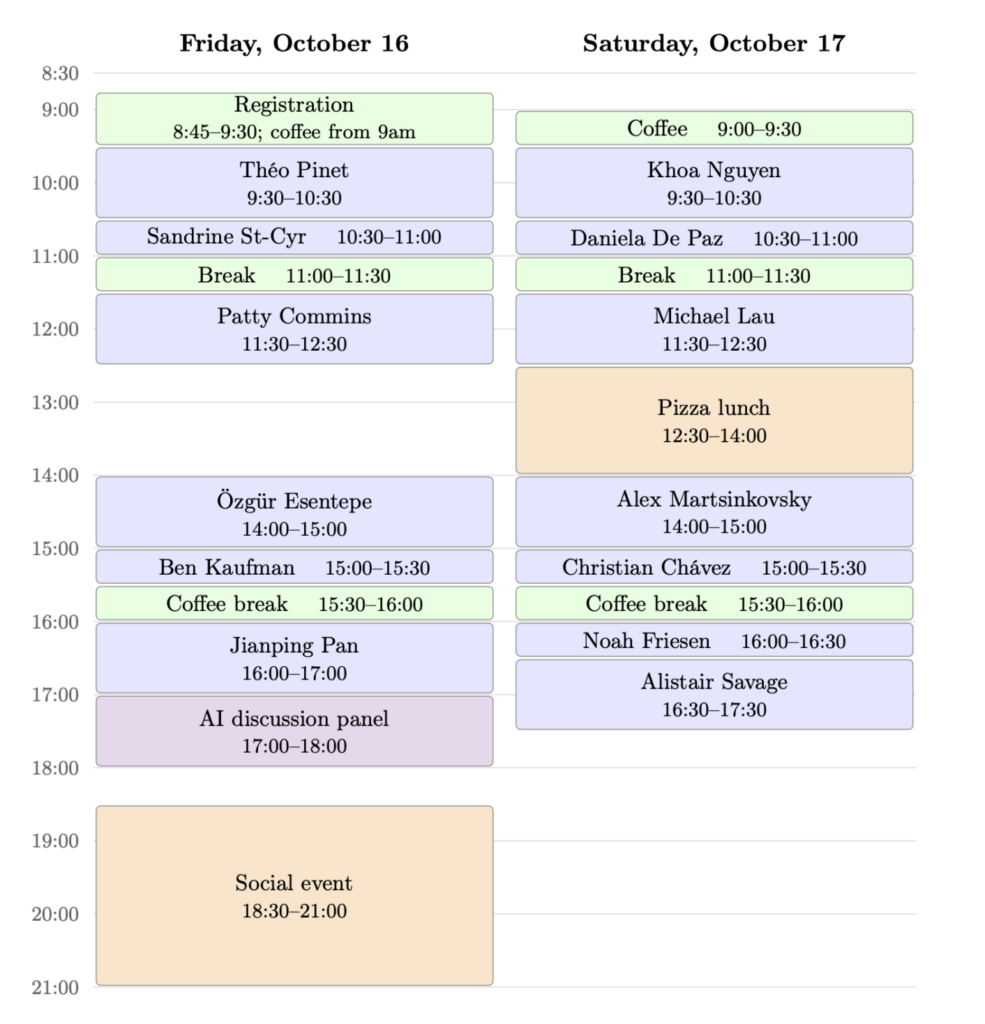
Titles and abstracts
Christian Chávez, Université de Sherbrooke
Interleavings and cluster categories arising from the circle
In the category $\operatorname{Fun}(\mathbb{R}, \operatorname{vect}(\mathbf{k}))$ of persistence modules, the indecomposables are given by interval modules, which satisfy $\operatorname{Hom}(\mathbf{k}^{[a,b]}, \mathbf{k}^{[c,d]}) \cong k$ whenever $c \leq a \leq d \leq b$. When we wrap the line onto a circle, we can recover this behaviour by introducing a category $\mathbb{X}$ whose objects are two-element subsets of $S^1$, which
play the role of interval modules. A monoidal action on $\mathbb{X}$ plays the role of rotation, which is the analogue of the shift of intervals on the real line, and it allows us to define an interleaving distance on $\mathbb{X}$, a notion first defined for persistence modules. On the other hand, finite full subcategories of $\mathbb{X}$ recover, after a quotient, the cluster categories of type A. In this talk, I will introduce this category and elaborate on both sides of the story.
Patty Commins, UQAM/LACIM
Signed combinatorics and the Mantaci–Reutenauer algebra
The Mantaci–Reutenauer algebra is a subalgebra of the hyperoctahedral group algebra that arises in algebraic combinatorics. In this talk, we will explore the representation theory of the Mantaci–Reutenauer algebra through the combinatorics of signed objects. In particular, we will determine its Cartan matrix and its representation type. We will also present a conjectural description of its Ext-quiver. This is ongoing joint work with Alice Dell’Arciprete.
Daniela De Paz. Università di Verona
A counterexample to the semidistributivity of the lattice of large torsion pairs
The lattice of torsion classes of a finite dimensional algebra encodes many important representation-theoretic properties of the category of finite dimensional modules. In particular, it was shown by Laurent Demonet, Osamu Iyama, Nathan Reading, Idun Reiten and Hugh Thomas that it is complete semidistributive. As a consequence there is a bijection between minimal inclusions of torsion pairs and isomorphism classes of bricks. Recent developments in the theory of infinite dimensional modules established connections between this lattice and infinite dimensional generalizations of support $\tau$-tilting modules.
It is therefore a natural question to ask if the lattice of large torsion pairs also satisfies this property. In a joint work with Hugh Thomas we studied this question and found a negative answer. In this talk we present a counterexample.
Özgür Esentepe, University of Graz
Contravariantly finite subcategories from regular sequences
Given a regular sequence in a Cohen-Macaulay local ring $R$, we will construct a contravariantly finite subcategory of the module category of $R$. Then we will discuss the exact structures on the category of maximal Cohen-Macaulay modules coming from this construction. In the Gorenstein case, this will allow us to talk about triangulated categories associated with our regular sequences.
Noah Friesen, University of Saskatchewan
Braid group actions and Yangians
Yangians are a type of quantum group that one can associate to a semisimple Lie algebra, and play a major role in representation theory and mathematical physics. From the same underlying data as the Yangian, one can also define the braid group, which acts on integrable representations of the Lie algebra. In this talk, we describe a modification of this action that produces a novel braid group action on a subalgebra of the Yangian, yielding several interesting consequences. This talk is based on joint work with Alex Weekes and Curtis Wendlandt.
Benjamin Kaufman, Northern Essex Community College
The extension conjecture and Koszul algebras with coherent Koszul dual
A strengthening of the strong no loop conjecture proved by Igusa, Liu, and Paquette, the extension conjecture asserts that for a finite dimensional algebra and a simple module $S$, $\operatorname{Ext}^1(S,S) $ nonzero implies that $\operatorname{Ext}^i(S,S)$ is nonzero for infinitely many $i$. The extension conjecture has been established for Koszul algebras with Noetherian Koszul dual by Bouhada, Huang, Lin, and Liu using techniques of Lenzing. However, this result also holds in the more general case that the Koszul dual is merely coherent. In this talk we will discuss a result characterizing finite dimensional Koszul algebras with coherent Koszul dual in terms of linearity properties of syzygies. We will also present some additional examples of non Koszul algebras with loops and exhibiting extension gaps — values of $i$ for which $\operatorname{Ext}^i(S,S) = 0$.
Michael Lau, Université Laval
Bridging the Jordan with TKK
Jordan algebras are commutative but non-associative algebras with origins in quantum mechanics and geometry. For any unital Jordan algebra, the famous Tits-Kantor-Koecher (TKK) construction produces an $\mathfrak{sl}(2)$-graded Lie algebra. We will look at weight representations for their universal central extensions, and discuss some combinatorial and homological finiteness theorems for algebras and bounded modules in these contexts. Some of the proofs are a bit tricky and appear to be related to deep classical theorems and recent structural results in Jordan theory. The talk will be based on joint work with Olivier Mathieu. No prior knowledge of Jordan algebras will be assumed.
Alex Martsinkovsky, Northeastern University
Universal theorems on universal coefficients
The simplest and most fundamental construct to have come to prominence in the modern representation theory of algebras is the Auslander transpose, a module-theoretic incarnation of the transpose of a matrix. However, it is meaningful only for finitely presented modules.
In this expository lecture, I will describe how the use of additive functors leads to an alternative formalism that completely bypasses the transpose and extends the classical results to arbitrary modules. The main tools are the recently introduced fundamental sequences associated with additive functors. These ubiquitous long sequences tie together stabilization, satellites, and derived functors. As an application, I will derive universal coefficient theorems that hold without any assumptions on the complexes. In classical contexts, the new results specialize to the familiar theorems.
Khoa Nguyen, Queen’s University
Simple $U(\mathfrak{h})$-free modules of finite rank over $\mathfrak{sl}(2)$
In this talk, we discuss a class of non-weight $\mathfrak{sl}(2)$-modules that are free of finite rank over $U(\mathfrak h)$, where $\mathfrak h$ denotes the Cartan subalgebra of $\mathfrak{sl}(2)$. In particular, I will present a classification of simple scalar-type $U(\mathfrak h)$-free modules of rank $2$ and introduce several families of simple finite-rank $U(\mathfrak h)$-free modules. We also discuss the decomposition of the corresponding coherent families obtained by applying the weight functor to finite-rank $U(\mathfrak h)$-free modules, which admit central characters. This talk is based on joint work with D. Grantcharov and K. Zhao.
Jianping Pan, Arizona State University
Uncrowding algorithms and crystal structures in K-theoretic combinatorics
Crystal bases provide powerful combinatorial models for representations of quantum groups, with semistandard Young tableaux being the classical type A example. K-theoretic Schubert calculus gives rise to richer families of tableaux, including set-valued and hook-valued tableaux, whose generating functions are stable Grothendieck polynomials and their canonical analogues. In this talk, I will describe how these K-theoretic tableau models can be understood through crystal-theoretic methods. A key tool for understanding these objects is an “uncrowding” operator, which relates more complicated tableaux back to classical ones while preserving structural features. Building on Buch’s uncrowding operator for set-valued tableaux, I will discuss a recent extension to hook-valued tableaux. By studying these operators, we uncover a “hidden” symmetry of hook-valued tableaux through jeu de taquin, using a classical result of Benkart, Sottile, and Stroomer. This talk is based on joint work with Jang, Kim, Pappe, Poh, and Schilling.
Théo Pinet, McGill University
Folding monoidal categorifications of cluster algebras
Cluster algebras are remarkable commutative algebras that arose from Fomin and Zelevinsky’s study of canonical bases. In this talk, I will use a notion of folding for these algebras to obtain a new cluster structure on a ring related to representations of quantum toroidal algebras. I will then, time permitting, give a geometric interpretation of this folding procedure and discuss possible applications to canonical bases.
Alistair Savage, University of Ottawa
Climbing the Temperley-Lieb tower
The Temperley-Lieb algebras form a natural tower, where moving up and down corresponds to induction and restriction. In this talk, I will describe a graphical calculus that makes these functors, and the natural transformations between them, visible. The calculus is built from a diagrammatic 2-category with generators for one-step induction and restriction, together with two-step summands coming from cup-cap idempotents. A key result is a basis theorem: morphism spaces have explicit bases indexed by bridges, a family of paths generalizing Dyck paths. This theorem shows that the graphical calculus faithfully captures the corresponding Temperley-Lieb bimodule theory. I will also discuss the decategorified picture, where standard modules are represented by homogenized Chebyshev polynomials, and idempotent completion leaves the Grothendieck ring unchanged.
Sandrine St-Cyr, Université de Sherbrooke
Classification of flat principal 2-group bundles via holonomy
Cette présentation portera sur la classification des fibrés principaux dans le cadre des 2-groupes. Intuitivement, un 2-groupe est un groupe dont les axiomes (par exemple, l’associativité) ne sont satisfaits qu’à isomorphisme près. Nous commencerons par introduire la notion de 2-groupe et de fibré principal. Nous expliquerons ensuite comment classifier ces fibrés à l’aide des données d’holonomie, puis nous illustrerons cette classification dans le cas particulier de la sphère.
I will discuss the classification of principal bundles in the setting of 2-groups. Roughly, a 2-group is a group whose axioms (such as associativity) are satisfied only up to isomorphism. I will start by introducing the notions of 2-groups and of principal bundles. Next, I will explain how to classify these principal bundles using holonomy data, and then illustrate this classification in the particular case of the sphere. This presentation will be given in French, with English slides.
AI discussion panel
We will discuss questions related to AI and mathematics, with a particular focus on advice for graduate students and early career researchers. Panelists: Charles Paquette, Ralf Schiffler, and Alistair Savage